Select your language

Duke Jacob's 400th Anniversary

Material Silver of fineness .925
Year 2010
Mintage 5000
Artists Graphic Design: Ilze Lībiete Plaster Model: Ligita Franckeviča Jānis Strupulis
This coin is no longer available for sale. The coin remains only in collectors’ possession and in our archive as a record of its history.

Product Description

Duke Jacob (1610-1681) is the most prominent member of the Kettler dynasty that ruled in the Duchy of Courland and Semigallia (1561-1795) until 1737. Officially, he was enthroned in 1642 after his Uncle Friedrich's death, though in fact he had governed the Duchy already since 1639.

Jacob was the godson of King James I, the King of England. Most of his upbringing was done at the Hohenzollern Court in Berlin. Jacob studied in Leipzig and Rostock and travelled over Europe. The broad vision he thus developed later allowed the Duke to modernise his realm. Seventy manufactories were established in Courland, representing a variety of industries starting with pig-iron casting and ending with tapestry weaving. Over 135 ships were built; urban craftsmanship flourished; churches and schools were erected. Courland's merchant marine, the largest in the Baltic Sea, shipped the Duchy's produce to many countries worldwide. France and England procured the ships built in the shipyards of Courland. Duke Jacob set up colonies on the Tobago Island in the Caribbean and the delta of the Gambia River in Africa. Apart from bringing international recognition to Courland, they promoted the transit of colonial goods. Though Duke Jacob loved art and culture, he never attempted to impoverish his country by copying the habit of the West European sovereigns of building luxurious palaces.

In 1645, Duke Jacob married Louise Charlotte, Princess of Brandenburg-Prussia, and their happy wedlock was blessed with nine children. However, similar to Latvia, both his family and the Duchy had a destiny determined by geographical location amidst great powers: in 1658, at the time of the Polish-Swedish War, Jacob and his family were taken prisoners by Swedes and held in detention for two years. The subsequent part of the Duke's rule was spent prevailingly in rebuilding the destroyed economy.

Duke Jacob has become a next-to-mythological personage embodying the image of the "good and smart" ruler. Yet, the continuation of his life is not a mere historical legend - the Kettlers' blood must be running through the veins of more than one royal family of present-day Europe.

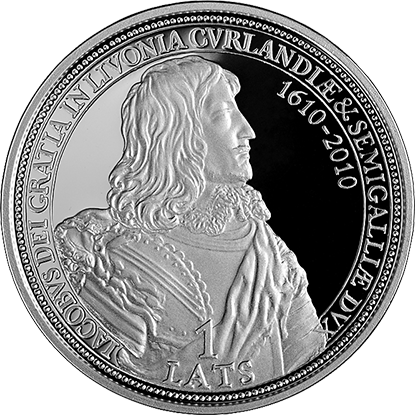
The obverse of the coin has been designed after a silver memorial medal, presumably struck in 1642, commemorating Duke Jacob's coming to power. Not a single copy of the medal could be found in Latvia after World War II. The Duke's proud profile will remind the owners of the coin of the talented and brilliant personality who took Latvia to Europe as early as several centuries ago.


Technical Description

Denomination: 1.00 Ls
Weight: 31.47 g
Metal: Silver of fineness .925
Diameter: 38.61 mm
Quality: Proof
Maximum Mintage: 5000
Year: 2010
Edge: The inscriptions LATVIJAS REPUBLIKA (Republic of Latvia) and LATVIJAS BANKA (Bank of Latvia), separated by rhombic dots
Mint: Koninklijke Nederlandse Munt (Netherlands)
Graphic Design: Ilze Lībiete
Plaster Model: Ligita Franckeviča, Jānis Strupulis
Obverse

Obverse

(front)

Duke Jacob's portrait in profile is depicted in the centre, with inscription 1 LATS below; the semicircular inscription 1610-2010 is placed on the right-hand side above; the inscription IACOBUS DEI GRATIA IN LIVONIA CVRLANDIAE & SEMIGALLIAE DVX encircles the central motif along the coin's edge.

Reverse

Reverse

(back)

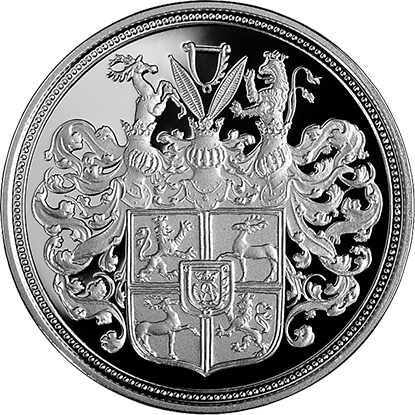
The coat of arms of the Duchy of Courland and Semigallia is in the centre.

Artists

Graphic Artist

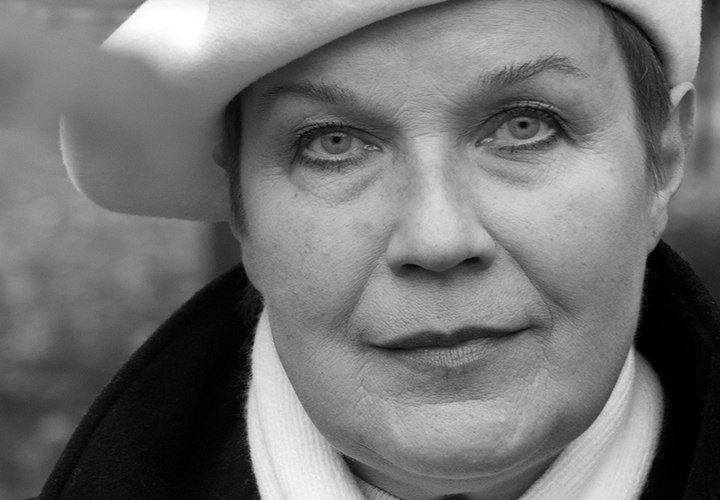
Ilze Lībiete

Ilze Lībiete is an exceptionally feminine artist, a master of quiet moods, working in half-tones, where delicate coloured or black-grey gradations softly touch the white paper, mirroring the depths of the human inner world. Among all graphic techniques, she favours chromolithography and silkscreen printing. Both techniques allow for a richly textured coverage of areas while enabling versatile line work – from loose, instinctive scratches to refined, smooth curves. Realistic images and specific...
Read more
Ilze Lībiete
Plaster Model

Ligita Franckeviča

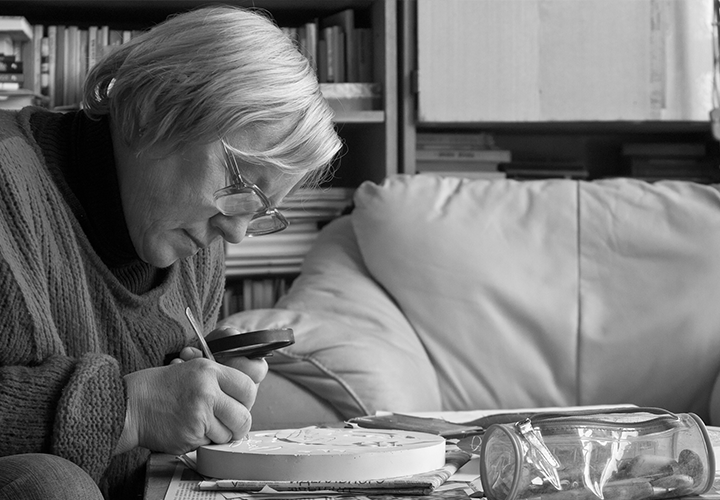
Born on 30 July 1947 in Tukums. Ligita Franckeviča has an innate talent for sculpting. If her artistic flair and skill reigned supreme, the world would be transformed into a realm of silky, rounded shapes, each flowing seamlessly into the next. It would be a world without dull planes, sharp corners, or jarring edges, where every thing is self-sufficient and every being – dignified and enveloped in gentle silence. A world swaying in the soft, velvety dance of light and shadow, at times...
Read more
Ligita Franckeviča
Plaster Model

Jānis Strupulis

After several years of collaboration on the silver coin series "800 Years of Riga," dedicated to Riga's anniversary, graphic artist Gunārs Cālītis had this to say about Jānis Strupulis: "He delivers exactly what's in the drawing, with flawless execution [..]; it is simply perfect. He is irreplaceable. He is an invaluable asset to Latvia, especially Latvijas Banka." "In essence, it's like maths," admits Jānis Strupulis, "there's only one correct solution. And it also ends up looking the best....
Read more
Jānis Strupulis